Wednesday, May 02, 2007

Brooks Jensen portfolio


Brooks Jensen portfolio.
I recommend downloading the PDF file. It's a beautiful collection, with nice and humorous captions.
I own his October Seas prints portfolio. Beautiful stuff.
More.

I asked Brooks about his use of the term "folio" for these photo collections:

Dear Brooks,
The interview on the Luminous-landscape video journal is excellent.
I am a little confused by your use of the word "folio" for the picture collections you sell. None of the definitions from my online dictionary really fit:
"The noun folio has 3 meanings:
Meaning #1: the system of numbering pages
Synonyms: pagination, page number, paging
Meaning #2: a sheet of any written or printed material (especially in a manuscript or book)
Synonym: leaf
Meaning #3: a book (or manuscript) consisting of large sheets of paper folded in the middle to make two leaves or four pages."
Is it incomplete, or am I being dull, or are you coining a new use?
Oh, by the way: will there be a PDF version of the new Wakarimasen folio on your site?
Yours, Eolake


And he wrote me back:
Eolake,
Well, I have to confess I'm redefining the term a bit by adapting a bit of both definition #2 and #3.
Years ago, I took a couple classes in handmade artist's books to try to find a way to use gelatin silver prints in a bound book, but I never did find a usable format that was practical. I even visited the Center for Photography in Tucson to see the artist's books with photographs in their special collection, but most of the ones they had were literally falling apart from the stress on the bindings. Finally, I just threw in the towel on the whole idea of binding and settled on the idea of loose sheets. I especially warmed to the idea when I realized that this method gave people the option of viewing the prints either as hand-held objects, or they could mat or frame them if they chose to.

To me, a "folio" is a collection of loose, unbound prints defining a content that is more like a book than a random stack of unsequenced prints. In my folios, I use a title page to lead things off, then typically a statement about the project, the images pages come next, sometimes an afterword is appropriate, and the last page is a colophon. They are sequenced, like a book, but loose, like a portfolio. It's my answer to the problem of how to include original prints in a book without doing tip-ins. I can do this type of presentation with gelatin silver prints, photogravure, inkjet prints, etc. I can include a sewn text signature or French fold component. I can even include a CD if it's called for in the project. It's turned out to be quite a flexible design idea that allows all kinds of individual adaptations.

I'm currently using a folio cover that is die-cut with a hole that allows me to place a title page behind the cover, showing through. This allows me to produce a large quantity of covers (amortizing the costs involved), and make folios for any project from one copy to hundreds. Again, flexibility is the key to the design.

I've never actually seen anything quite like the folios I produce, so there really isn't a term for it. I've been forced to make my own definition. I even tried to find a latin root that I could adapt, but folio seemed the best. I've used this term since 1992 when I made the original Made of Steel folio.

Yes, we will have a PDF of the folio posted on the website tomorrow. We almost had it finished today, but we decided to add a video component to the website that shows the folio being opened and the individual prints.

Hope this answers your question! And, thanks for asking.

Brooks Jensen

Soon

"When are you going to tell them!?"

"Soon."

"When is 'soon'?"

"When the big hand hits the S and the little hand hits the 'oon'."

- Gilmore Girls

Stephen Gillette photography


Stephen Gillette photography.
Huh!
Unusual stuff.

Tuesday, May 01, 2007

"Nephew", Danish band

It seems Denmark has a new pop sensation, the band Nephew. And it looks like the country and even individuals are in two minds of whether it's great or crap. At first glance I kinda like their song Igen og igen og. ("Again and again and".) I think they'll go places.

Humor

I've come to realize that almost all of films and TV shows I really appreciate have some element of humor. Though often subtle or different.

I think that humor is not a... thing you do. It's not a technique. It's not something added. It is a basic thing. I think humor is a perspective on life.

Being able to laugh is to be able to put yourself at a healthy distance to life.
To see the absurdity of it.
And to be able to process and get through pain.

And writing or creating funny things is the ability to help others do this. Which is a substantial gift, hugely valuable.

Meryl Streep singing "I'm Checking Out"


Meryl Streep singing "I'm Checking Out". One of my favorite movie songs of all time, from one of my all time favorite movies.
(First time I saw this was with my likkle sister in the movies. When the titles rolled over the last half of this, she was dragging my arm to get out of the theatre. I wanted to watch the song!) (Gee, thinking about it, I think it must have been the second time. I think I watched this movie even more times than I've watched Blues Brothers.)

I've posted on Meryl here and here. The last one includes an MP3 file of the song above, if you like it.

I guess most people don't consider her one of the prettiest stars in Hollywood. Perhaps beautiful, but not pretty. I'm wondering, what if she had been really pretty also? Would people then have not been able to see her talent? Gotten less respect? Or would she just have been totally untouchable, above competition?

Monday, April 30, 2007

Nimbus motorcycle


I just want to share an image I saw once. If I ever do films, I want to put it in.

I late nineties I lived in a beautiful spot outside Copenhagen, named Lyngby. Good connections, beautiful parks and lakes, and ample shopping, and still a lot of old-Danish feel to it.
If you look here, under pizzerias, you'll see Big Mama's Pizza House listed. This is literally right next door to where I lived, so I came there often. But in honor of exact truth, Lyngby Pizzaria (next item listed) where I also came, is where today's story took place.

One nice summer afternoon I walked down there, and outside was parked a Nimbus Motorcycle. This is an old Danish bike which is a classic. I once sandblasted the frame of one, and guess what: the design is so simple that it's flat iron, not pipes. Wonderful machines.

So I admired it and went in to get my lunch. And inside was the owner, a lean, forty-ish man. He had a simple, old-style, black helmet on the table next to him. No visir, just a simple classic design. And he had his daughter, a beautiful eleven-ish girl with long, platinum-blonde hair. And she had the same kind of helmet next to her!

And of course after their meal these two understatedly gorgeous people got out, put on their respective black helmets and got onto the classic old black motorcycle, her in the sidecar.

That is style.

Nikon Camera Reviews

Nikon Camera Reviews
A review site for the Nikon D200 and Nikon D40 cameras.
-----
Also, Mike Johnston has some interesting comments on the high-end (price-wise) Leica M8.

Sunday, April 29, 2007

Siouxsie and the Banshees


...But by the eighties I had cut way ahead of the pack. I don't think many of my original class mates were into Siouxsie and the Banshees.

I came to think of them now because of my neighbor and friend Christine. I always want to add "the strawberry girl" to her name.

Siouxsie and friends are/were Iggy Pop fans. Here they cover his song The Passenger.
And like Iggy, Siouxsie had big influence on bands that would become much more popular than themselves. Ever the fate of the avant-gardist.

A bit of nice dancing in Hong Kong Garden.

Saturday, April 28, 2007

Forgive Your Enemies

[Author unknown]

Sunday's sermon was "Forgive Your Enemies."


Toward the end of the service the minister asked, "How many of you have forgiven you enemies?" People in the congregation began to raise their hands. Eventually all had answered in this manner except one old lady.

"Mrs. Jones," the minister said as he motioned to her, "are you not willing to forgive your enemies?"

"I don't have any," replied Mrs. Jones, smiling sweetly.

"Mrs. Jones, that is very unusual," continued the minister. "How old are you?"

"Ninety-Eight," she replied.

"Ninety-eight! That's incredible! People, I think we can all learn something from Mrs. Jones this morning," he said to the congregation. He then motioned back to Mrs. Jones and said, "Please come down in front and tell us how a person can live ninety-eight years and not have an enemy in the world."

The little sweetheart of a lady tottered down the aisle, faced the congregation and said, "I outlived all those useless, good-for-nothing idiots!"

Bill Atkinson


Bill Atkinson is an outstanding computer engineer who worked on the original Macintosh, and invented many basic concepts now in use, like the Menu Bar, and he created the world's first paint program, MacPaint.

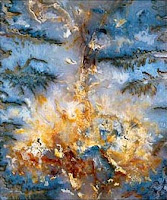
He is now working as an engineer in color printing fidelity, and also as a fine art photographer. His new (first) book Within The Stone has groundbreaking color intensity and fidelity for four-color printing. He is photographing the inside of polished rocks and getting amazing, abstract results.

I have just watched an interview with him on Luminous Landscape video Journal, and the sheer work and care this man puts into precision and fidelity is just breathtaking. His whole philosophy, which he sticks to rigidly, is to never change anything, he wants to get the photograph looking exactly like reality. And the funny thing is that by photographing just the right things, he somehow gets art anyway.

The story he tells in the interview about printing the book is fascinating. He couldn't find any American printer who was willing to work with him to improve the color printing technology. (Not changing the printing presses, only fine-tuning their use and color profiles, apparently.) But he worked with a Japanese one. They printed his book, and they got their machines optimized. It took six trips to Japan!

The amazing thing is that after this was done, this Japanese printer now has a press which prints far higher quality and richer colors, perfect precision, far above industry standard. And they can print much faster than before, no trial and error, which is essential, for running a press in Japan costs $8,000 an hour, so it saves big money. And still other companies in the printing industry are very reluctant to go this route.