Notes on life, art, photography and technology, by a Danish dropout bohemian.
Tuesday, October 05, 2010
New Panasonic pancake
It's harder to make good wideangle lenses, but this is a rather slower lens (one stop slower), so I think there's hope it can be about as good as the 20mm.
For sure the size is amazing: even smaller than the 20mm, and only 55 grams! That's ridiculous.
I think a good walk-around gear would be a Pentax K-x or K-r with the outstanding and very compact 70mm F:2.4, and the Panasonic GF1 with the 14mm lens, in a pocket. The Pentax won't fit in a pocket, but you can sling it onto your back when using the wide-angle camera.
Why not use a zoom? Hard to say. There's a bit of snobbery to it, perhaps, but you do get extra zing to the pictures with a good prime lens, and they are much more compact. And there's a peculiar pleasure in composing to a fixed focal length, even as there's also much convenience in the instant composing with a zoom.
(I can't believe they haven't updated the GF1 yet. I hope they'll do something great with it, unlike with the G2, which was a pretty trivial update.)
Wednesday, September 02, 2009
The Panasonic GF1 camera and Lumix G 20mm f/1.7 ASPH. lens

The Panasonic GF1 camera and Lumix G 20mm f/1.7 ASPH. lens, article.
Every year, we get a little closer to a real "street camera".
Me, I'm still waffling: zoom or no zoom. I'm attracted by a compact, fast, and sharp lens like this 20mm promises to be. But on the other hand, when I'm out photographing, I find myself zooming constantly for different framing.
Back on the first hand though, if I only have the one lens and focal length, maybe I will only think in that view angle, and maybe even work more efficiently? Waffle waffle.
Friday, October 16, 2009
Blur on the 20mm (updated)
Normally you don't use a smallish sensor camera for good background blur (the GF1 as a Micro Four Thirds camera is in-between DSLR cameras and compacts with regards to this), but with a fast lens, you can get some if you try.
This lens has a pretty nice "bokeh", which is a fancy (japanese) word for the qualities of out-of-focus blur in photos. Some lenses (particularly zooms) gives it hard edges which is normally less aesthetic than smooth, soft blur.


While the bokeh does look ok here it certainly doesn't get into the kind of creamy niceness you can get with a 70-200/2.8. It's hard to get anything at small focal lengths in the best of lenses. What aperture were these shot at? f/1.7? An improvement over a P&S I guess.
You're right, for really soft background, one needs a bigger format and preferably longer focal lengths.
Again, the MFT format is in-between in this aspect too. (Yes, this was F:1.7.)
"Were ya on yer belly for that grass shot"
Nope, that's one of the good things about live screen cams over DSLRs.
(Especially if the screen is hinged.) (Which it isn't on the GF1, sadly, maybe my only real misgiving about it.)
Yes, many new DSLRs have live screens too, but sadly their autofocus is *very* slow in this mode. So far Panasonic is the only company to have out cameras with live-screen autofocus which is pretty speedy.
Monday, October 12, 2009
Panasonic 20mm lens (40mm-equivalent)

I'm a little disappointed that Panasonic's new compact prime lens (non-zoom) Micro-Four-Thirds 20mm F:1.7 does not have stabilization (or the camera body). It would be nice, because otherwise it's a real damn pleasant lens, physically and optically. It's the equivalent of a 40mm lens in 35mm film terms, and very compact.
(And the lens with the Panasonic GF1 actually fits in my pants pocket. Although visibly. "Is that a GF1 in your pocket, or are you just glad to see me?")
But even though I think no stabilization is just stupid these days, I can live without it if I have to, in this case. For one thing, the lens is sharp at full opening. For another thing I have found out that if I'm not too rushed, I can take a sharp picture at 1/15 of a second, with a 40mm-equivalent lens. I honestly did not think I could. I used to get the occasional shaken picture at 1/125.
Either the cameras and shutters have gotten better, or I have. I suspect both are true.
Lookit this picture. At 400ISO, 1/15 second, F:1.7, hand-held. The picture looks like there was much more light than it looked like in reality. That end of the corridor is very dark. (Oh, obviously that is not a flash which is reflected on the door, I didn't use flash.)
I did not sharpen the picture in the computer, in the interest of objectiveness.


I used to think that if I had a "street camera" with just one lens and no zoom, it should have a 28mm lens or a 35mm. But I might just be coming around to Sally Mann's and Mike Johnston's position that there is something "Goldielocks" about a 40mm. It takes in the scene naturally. 50mm is a bit too long, it's a shame that it became the defacto "normal lens" for some reason or other, despite the diagonal of the 35mm format, 43mm, being closer to 40.
Friday, April 27, 2012
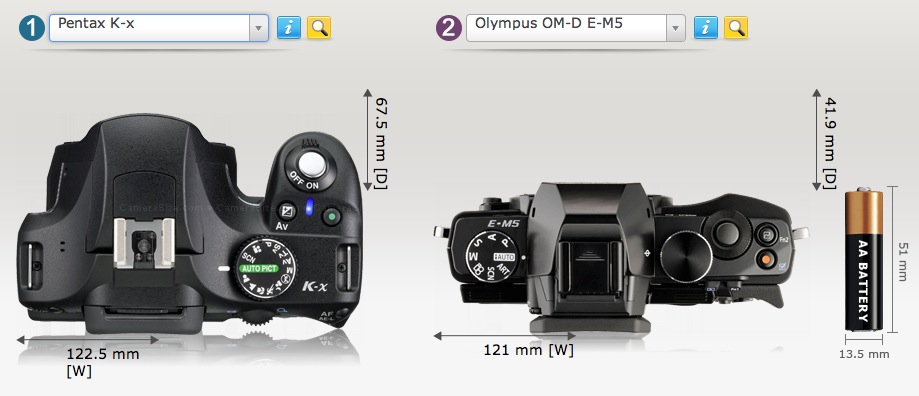
Micro Four Thirds size (updated)
(From camerasize.com)
Many professionals have started to use the M4/3 system, and that's even before the rather more capable and solid OM-D model hit the market. I think the system has a very interesting future for enthusiasts. Scratch that, already the present is very interesting, the future possibilities blows my likkle fragile maaahnd.
Below is a comparison which may actually come closer in terms of quality and capabilities, the Canon 60D and the OM-D. Look at that size difference! And the D60 is not a large camera for a mid-level DSLR.
Tuesday, October 13, 2009
20mm lens part II, Revenge of the Sith
Friday, December 04, 2009
Shooting with a prime
Gordon wrote in his review:
"Shooting with the GF1 and 20mm took us back to the Seventies and Eighties when we used manual 35mm SLRs with nothing more than a 50mm lens. Back then we didn’t miss a zoom, and it’s amazing how liberating it can still be today when you’ve become used-to adjusting your focal length."
Yes!
When you have a zoom, you love it. But when you use a prime, you find out how much attention you have used, apparently, in thinking about pictures in many different focal lengths at once. One can think much quicker with a prime.
Also I found out that I can take sharp pictures at 1/15 second with the GF1 and the 20mm pancake lens, even without stabilization! It surprised me. That and F:1.7 and ISO 800 goes a long way (even if ISO 1600 really should have been better on that camera).
Wednesday, October 21, 2009
Another GF1 review
Like me, they like it and think it's one of the rare camera which makes photography fun again, as well as being capable of making very high quality pictures if used right.
"the GF1 is a camera that simply cries out to be used and, for this occasionally jaded user at least, puts the fun back into photography. [...] once you attach the wonderful 20mm F1.7 pancake it becomes something special; an unobtrusive creative tool that you can carry anywhere, and one that's capable of superb photographic results.
When I started using the GF1 I didn't think I'd use the 20mm F1.7 that much (too many years using zooms), but once attached I rarely took it off. The 40mm equivalent focal length is both restrictive and yet surprisingly liberating from a creative point of view, and took me back to my earliest days of photography using a Pentax Spotmatic with a single 50mm lens. And you can stick it on a wrist strap and basically carry it with you wherever you go."
-
Monday, January 04, 2010
Samsung and Pentax compact SLRs (updated)

Samsung NX10, new format exchangeable-lens camera, which like Micro Four Thirds is mirror-less. And the format is bigger than M4/3. Might be interesting!
Talking about Samsung, right now you can get a super-zoom camera for $230. Man, that's cheap!
In other camera news, DPreview has posted a highly positive review of Pentax' very compact and economical K-x model. Which I think is kewl, because CaNikon needs the competition, and because I used to use Pentax, and because I like compact cameras.The K-x is indeed super-compact, actually barely larger than the Panasonic G1, which is a smaller-format camera. And pretty cheap too, £550 in the UK, and typically much cheaper in the US, $560. And I think it's the only camera which has stabilization (though not the best on the market) even if you use it with a pancake (compact) lens, of which Pentax has more than anybody else.
Despite the size, it's no kids' camera, it will shoot almost 5 frames per second and has ISO settings up to 6400, and not just for show either. Impressive.
Update: DPReview has samples, I think the 1600 ISO ones are nice, certainly tons better than the M4/3 cameras', and impressive for such a tiny camera.
From the review:
Lining the K-x up against its most direct competitors makes it apparent just how compact it is. It's noticeably smaller than the Canon EOS 500D and Nikon D5000 and, especially in combination with Pentax' 40mm pancake lens, makes a very compact package that is very well suited for traveling.
Remarkable, I did not think they could make a DSLR smaller than the 500D.If I were Pentax, I'd (also) sell the camera in a kit with one of the pancake (very small) lenses, for instance the DA 21mm (32mm-equivalent). Just to make a point about the super-compact-ness. To get top-of-the-class performance in a package this compact really is something they should point out.
And I think the 21mm lens goes well with the DA 70mm 2.4 lens, which is barely larger than the 20mm, I have never seen anything like that in a 105mm-e lens.


Update Nov 2011: I now have the K-x, as well as the K-r and the K-5. They are all outstanding cameras, and whereas I am a bit lukewarm about the Pentax 18-135mm zoom (a bit soft at the edges), these prime lenses are fantastic, compact and dead-sharp.
Wednesday, October 06, 2010
Panasonic GH2
Well, how about that. No GF2 yet, but there's a GH2, and it has just what I was looking for: (at least claims of) super-fast handling and autofocus (they say it's faster than a good DSLR!), and much-improved high-ISO performance.
It would surprise me if these are not real, and if they don't also make it into the next-gen GF camera. Kewl.
Update: Yes, it is super-fast, but it depends on the lens. The 14-140mm lens is designed to be extra fast. The older 20mm lens is much slower in focusing.
Wednesday, February 03, 2010
Olympus PEN E-PL1
It could be interesting with the Panasonic supercompact lens 20mm F:1.7, adding the missing image stabilization to the latter, and being more compact yet than the Panasonic GF1, though maybe not a lot in practice.
Here's a practical round-up page for the camera.
Monday, January 18, 2010
Wet and Windy


Photos from Brighton, UK, with Panasonic GF1 and 20mm lens (40mm-equivalent).
Tuesday, October 13, 2009
How light changes things
And the thing is, it's hard to see on that photo, but actually it's a dark blue door.
On the outside and from new, it is a very dark green, so dark that it has to be good light for people not to mistake that for black too.
But I painted the inside blue to match all the other doors in the apartment, when I painted those. It's a gorgeous, deep color.
(And really I don't think that any of the doors, including this one (the front door) are actually even real wood. But they have the texture, and it shows through the paint in a very pleasing way.)
How the light is changes the way things look and feel to an amazing degree. Just look at these two pictures, with and without flash... you wouldn't believe it's the same door.


Here's the outside of the door:
And below, with the flash on. (That's why pros tend to use indirect light: the flash on the camera flattens things out in a generally un-pleasing way.)

And closed, seen from the outside:
Today is a nice, bright day, so you can see the deep green color. In just a bit dimmer light, people tend to think it's a black door. Again, light changes things much more than one would believe.
Wednesday, January 06, 2010
Market Hall today

-----
Panasonic GF1 with 20mm F:1.7 at 5.6, 1/320 second.
This is an excellent lens, see all that detail.
Amazingly, the ghost is just the reflection of the yellow lamp in the window I'm shooting through! They must clean the hell out of that window, it's totally invisible.
All on auto, except I had to point the autofocus past the central lamp.
Also, for some odd reason this camera, on Program mode, tends to favour really big apertures, even when the shutter speeds are into the hundreds, dunno why. I think it had selected 2.4 and 1/800 sec or so. Silly. So I set it to aperture priority to get the depth of field. (Although actually with the smallish format and the wide-ish lens, even 2.8 would have sufficed, I think.)
Tuesday, November 03, 2009
Rain and darkness
I'm quite pleased with the photo though.
(Panasonic GF1, 20mm F:1.7, full opening.)I love the speed you can do things with these days. From idea to publication in 8 minutes! This is power (article I wrote ten years ago).
Tuesday, December 22, 2009
Xmas Snow, photos from today
------------
Technique: much as I love the Panasonic GF1 with the sharp and compact 20mm lens (40mm-e), these were taken with the G1 with the kit zoom. The kit zoom is sharp, also compact and flexible, and is stabilized. Also, the tiltable screen on the G1 is very helpful in changing the height of your viewpoint, both above your head, and all the way to the ground without having to lie down in mud or snow. I find this camera is my "default" camera for flexible all-round shooting.
Friday, September 18, 2009
Pana GF1

The Panasonic GF1 looks very promising quality-wise, especially for such a compact camera, look at this for the 20mm (40mm equivalent) at F:8, at this for the same tiny lens at F:1.7 (wow), and at this for the camera's ISO 1600 performance. (At those pages, click for big pic.)
Images overview. Camera overview.
Admitedly I wish it had in-body stabilization and a hinged screen, but apart from that, it looks like one of the best combinations we've seen yet of high quality and compact size, for street and travel use. (With the little lens it fits in a big jacket pocket or a small purse.)
It's the same size as the Olympus EP-1, but the autofocus is much more on the ball than with the Oly.
Monday, April 30, 2012
DPreview looks at the OM-D
The E-M5 sets a new benchmark for Micro Four Thirds images, thanks to a modern sensor and Olympus' excellent JPEG engine. It continues to produce good results in lower light than was previously practical and produces attractive output in all but the most challenging of situations. The combination of its small body and the small lenses available for it (specifically the Panasonic 20mm F1.7 and Olympus 45mm F1.8) mean it's a camera we found ourselves taking everywhere, without any concerns that we were having to make undue compromises on image quality.
[...] If you're absolutely unwilling to compromise on image quality then spending twice the money and moving up to the bulk of a full-frame is the only way of gaining a significant step up from the E-M5.
I wonder why the kit lens is so huge? It seem incongruous. OK, it is weather-sealed like the camera, but still. So far, it seems that if one really wants to optimize the camera's compactness, prime lenses are the way to go.
Like Bert also said to me, something like: there are already amazing lenses for the M4/3 platform, and with this new distinctly semi-pro camera having arrived, we can probably look forward to much more of those.
Thursday, October 15, 2009
Valley tree, October (updated twice)

Panasonic GF1 with 20mm F:1.7. (The combo weighs less than a pound.)
This came out more powerful than I'd dared hope for.
Part of it is that (due to the sky) I used auto-bracketing, and selected a lighter version than the otherwise perfectly serviceable auto setting had chosen. More light in the picture, see.
Update:
Here's another pic from today. I liked the funny juxtaposition of this grey environment and those brightly colored bits.

Update:
TC [Girl] said:
I really like the contrasts of the brick wall vs. the colors, like you mention (and thanks for including that. That helps a great deal to interpret/confirm what you are trying to show in the picture...for amateurs like myself. :-) The pic looks like a B/W pic...with just those few bits colored in.
Thanks, dear.
It is funny, once I get into "picture mode" I see pictures everywhere. I was just walking home, a bit bushed, so I kept putting the camera in my closed pocket on my thigh (The GF1 with this lens is just small enough for a large pocket), and then I had to take it out again several times on the way. The grey picture was very close to home, well after I'd decided I was burned out creatively for the day.
Tuesday, August 10, 2010
Panasonic G1 good deal
The G1's brother, the GF-1 (not yet in a 2.0 version) fits in a large pocket if fit with the excellent compact 20mm 1.7 lens. The G1 does not. But I would say that the G1 is about as compact and light as you'll get, and still get the good handling and flexibility of a full sized, semi-professional camera. It's about the perfect walk-around and vacation camera for the serious amateur.